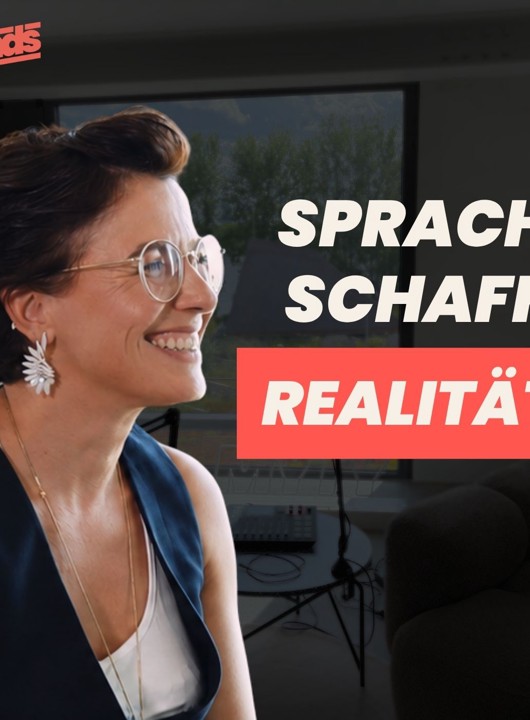


Claudia Gersdorf was born in the former GDR and wasn't viable for the first 30 minutes of her life. Only an adrenaline injection saved her, though with lasting impairments. Growing up at a school for physically disabled children, surrounded by doctors and teachers who told her she couldn't handle more, she fought her way, against ten school rejections, into a regular Gymnasium at age 12. Today, Claudia is an entrepreneur, coach, and human rights advocate who trains young people and visits schools as an ambassador for values.
Instead of "disability," Claudia prefers to call it her "diversity bonus": people who appear different from the outside are, in her view, naturally skilled at finding solutions rather than just seeing problems. She sees this as her own form of rebellion, not just swimming against the current, but actively pointing out new paths.
In this conversation, Claudia talks about why she consciously decided against a brain chip 20 years ago, even though it promised an easier life, and how she learned to train her mind the same way she trained her body. She explains her model of moving from "I" to "we" to "system," the image of autopilot and co-pilot for lost self-determination, and why we're increasingly forgetting how to build real human connection because we rely on technology instead.
In the end, the conversation turns to Claudia's critique of how inclusion is currently implemented in Germany, which she calls destructive, and to her vision of building her own movement-focused school for Germany.
In this conversation we discuss:
- how an adrenaline injection at birth shaped Claudia's entire life
- how to deal with your own inner commentator, the one that constantly judges and evaluates
- why she consciously decided against a brain chip 20 years ago
- what the image of autopilot and co-pilot reveals about lost self-determination
- which stereotypes and conditioning we should actively unlearn
- why Claudia calls inclusion in Germany, as currently implemented, destructive
- what Claudia's vision for her own movement-focused school in Germany looks like
Timestamps:
00:00 — Intro
01:20 — Welcome and Claudia's story in brief
02:45 — Growing up in the GDR: training without a choice
10:00 — The moment at 12: fighting to change schools
12:00 — Autopilot and co-pilot: the danger of convenience
20:15 — Viva con Agua, bullying, and going public
24:00 — "Stand up, what do you want?" – the turning point in coaching
26:05 — The chip question: why Claudia said no 20 years ago
31:15 — Authorship instead of victim/perpetrator thinking
34:40 — The vision: a movement-focused school for Germany
38:05 — The trust problem in the media landscape
40:30 — Education, creative intelligence, and the fun factor
43:15 — Inclusion in Germany as destruction: the comparison with Canada
49:05 — What we can learn from the French
59:00 — The most important advice: stay loyal to yourself
